ANDRE Carl (Quincy, Massachusetts 1935 - Manhattan, New York 2024),
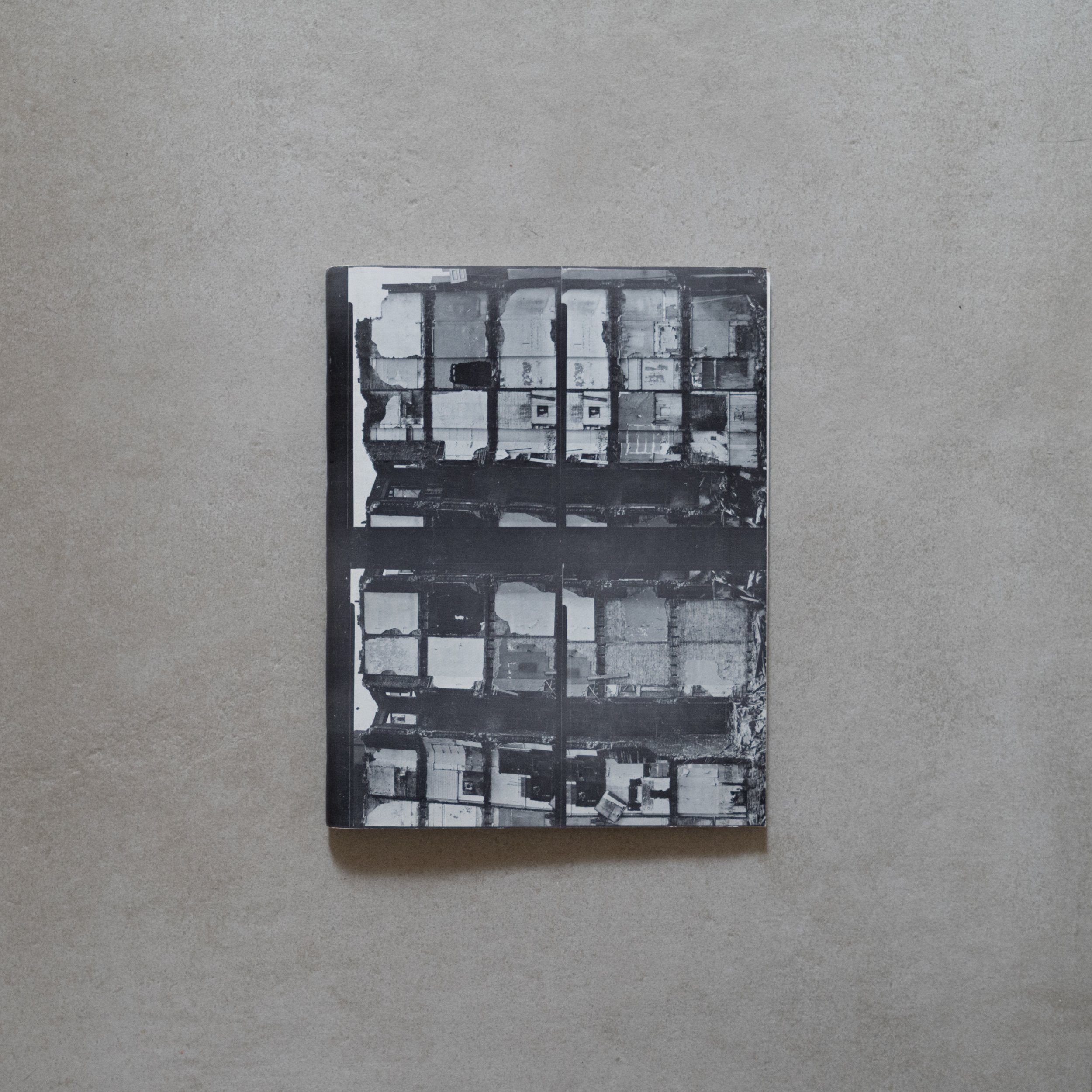
Turin, Sperone Editore, [printed by: Tipografia Petrino - Torino], 1974 (April), 30,7 × 30,7 cm, paperback with slight yellowing of the cover edges, pp. [24], artist's book illustrated on the cover with the titles of the eleven poems and 11 plates printed in black and white on the recto only with the photographic reproduction of each poem in the original handwritten version. These poems are characterized by the absence of punctuation and the irregular orientation of the letters, the arrangement of the texts is ordered mainly in a rectangular space while in some cases it is divided into blocks of words that make up more complex geometric figures. Edition of 1,000 copies. First edition.
[Bibliography: Delcroix 2011: p. 86 with illustration e p. 423; Lailach 2005: p. 87].
"An observable connection exists between Carl Andre’s minimalist sculpture and his poetry. Just as the sculptor famously abandoned welded, relational and vertical sculpture in favor of standardized elements placed on the floor, the poet approaches language as a concrete, complex matter that can be broken down to single units and then reordered in non-hierarchical, non-relational ways. Dismissing punctuation, Andre juxtaposes words, stacks them in columns or places them in patterns, thus creating resonant connections and calling attention to the poem’s space: the field of the white page” (www.paulacoopergallery.com).
"My poems are clastic textiles. That is, my poems are reweavings of fragments of pre-existing texts, mostly not by me. I do not, in my poetry, try to find the words to express what I want to say. In my poetry, I try to find ways to express what the words say” (Carl Andre, May 21, Glares, 2005).


 Image 1 of 6
 Image 2 of 6
 Image 3 of 6
 Image 4 of 6
 Image 5 of 6
 Image 6 of 6