

 Image 1 of 1
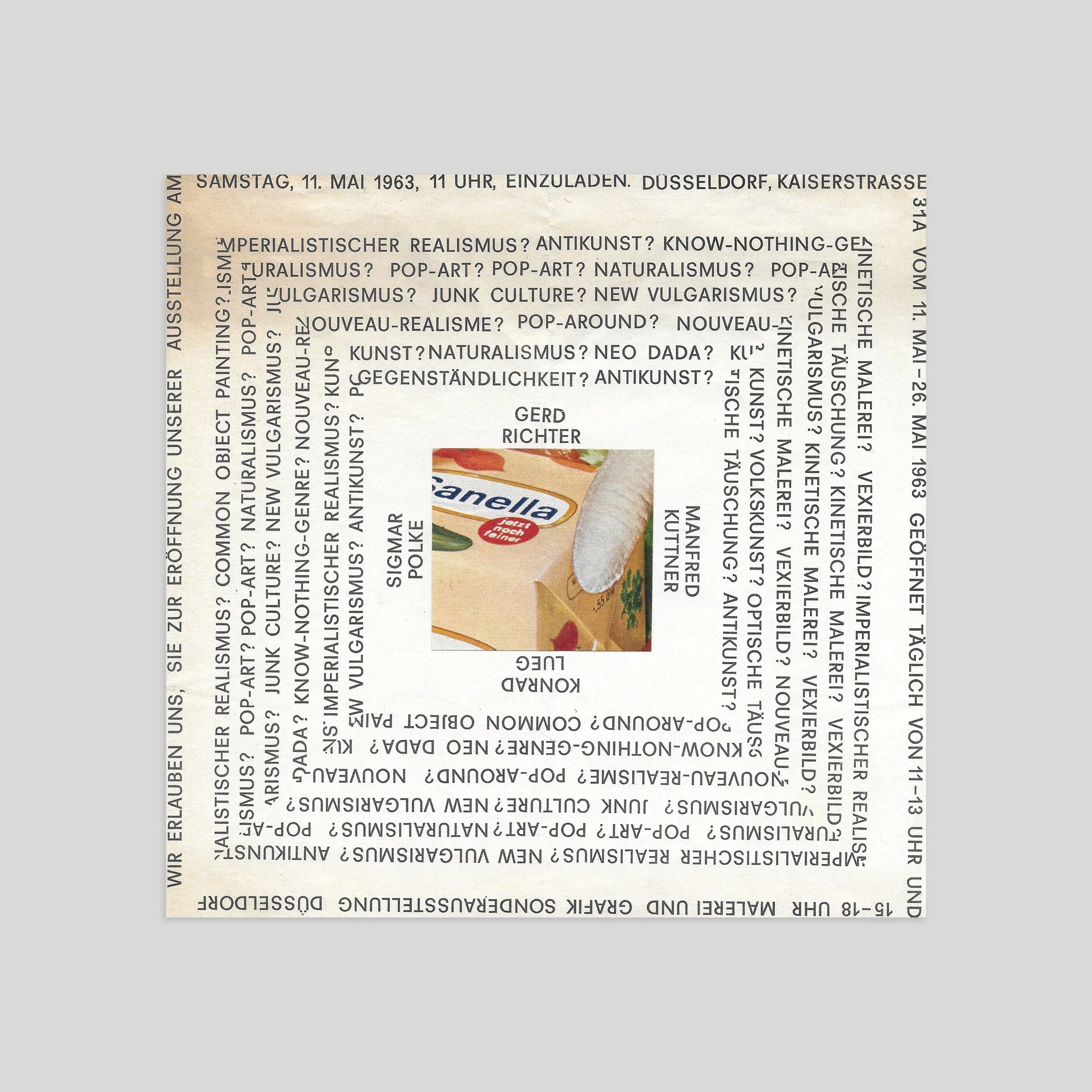
Düsseldorf, Ladengalerie, 1963, 20,6x21 cm. typographic invitation sheet with a collage, published on the occasion of the group exhibition (Düsseldorf, Kaiserstraße 31A, May 11-26, 1963).
"This iconic exhibition, regarded as the beginning of capitalist realism, began with the friendship of four young artists: Manfred Kuttner, Konrad Lueg, Sigmar Polke, and Gerhard Richter. Kuttner and Richter met in the mid-1950s at the Dresden Academy of Art during the GDR, from which they both fled in the early 1960s. From 1961, Kuttner studied in K.O. Götz’s class at the Kunstakademie Düsseldorf, which was also joined by Sigmar Polke and Konrad Lueg (Konrad Fischer) in 1962. Gerhard Richter attended the open days of the Kunstakademie Düsseldorf in 1961, and met not only his friend Kuttner but also Polke and Lueg. He soon also joined Götz’s class. With reference to earlier artist groups from the 1950s, such as Gruppe 53, Konrad Lueg proposed starting a new artist group that would challenge all existing art forms. It was only after they had discovered American Pop Art through an article in Art International (“Dada Then and Now” by Barbara Rose) that all four artists began looking for a space to rent in Düsseldorf in order to hold a group show. They proclaimed this exhibition to be the beginning of German Pop Art. Renting a former butcher shop for 8 days at Kaiserstraße 31a, the artists wrote a press release that stated: “The significance of the exhibition arises from the subject matter of the works. For the first time in Germany, we are showing pictures characterized by terms such as Pop Art, Junk Culture, imperialist and capitalist realism, new objectivity, naturalism, German Pop, and several similar notions… We believe that it would be necessary for the newsreel to document this first exhibition of 'German Pop Art.'” Each square-shaped invitation was unique, holding a different press clipping from Barbara Rose’s article in the center, while text referring to artistic movements and programs mentioned in the article surrounded the clipping. The exhibition received a lot of positive responses from the media and led all four artists to become well-known. However, within a year the group began to argue, due to competitive behavior and shows that excluded particular group members. After several exhibitions together, for example at Galerie René Block and Galerie Parnass, the artists held their last group show in 1967." from AdA invitations https://ada-invitations.de/cpt-einladungen/kuttner-lueg-polke-richter-ladengalerie-duesseldorf-1963/
Düsseldorf, Ladengalerie, 1963, 20,6x21 cm. typographic invitation sheet with a collage, published on the occasion of the group exhibition (Düsseldorf, Kaiserstraße 31A, May 11-26, 1963).
"This iconic exhibition, regarded as the beginning of capitalist realism, began with the friendship of four young artists: Manfred Kuttner, Konrad Lueg, Sigmar Polke, and Gerhard Richter. Kuttner and Richter met in the mid-1950s at the Dresden Academy of Art during the GDR, from which they both fled in the early 1960s. From 1961, Kuttner studied in K.O. Götz’s class at the Kunstakademie Düsseldorf, which was also joined by Sigmar Polke and Konrad Lueg (Konrad Fischer) in 1962. Gerhard Richter attended the open days of the Kunstakademie Düsseldorf in 1961, and met not only his friend Kuttner but also Polke and Lueg. He soon also joined Götz’s class. With reference to earlier artist groups from the 1950s, such as Gruppe 53, Konrad Lueg proposed starting a new artist group that would challenge all existing art forms. It was only after they had discovered American Pop Art through an article in Art International (“Dada Then and Now” by Barbara Rose) that all four artists began looking for a space to rent in Düsseldorf in order to hold a group show. They proclaimed this exhibition to be the beginning of German Pop Art. Renting a former butcher shop for 8 days at Kaiserstraße 31a, the artists wrote a press release that stated: “The significance of the exhibition arises from the subject matter of the works. For the first time in Germany, we are showing pictures characterized by terms such as Pop Art, Junk Culture, imperialist and capitalist realism, new objectivity, naturalism, German Pop, and several similar notions… We believe that it would be necessary for the newsreel to document this first exhibition of 'German Pop Art.'” Each square-shaped invitation was unique, holding a different press clipping from Barbara Rose’s article in the center, while text referring to artistic movements and programs mentioned in the article surrounded the clipping. The exhibition received a lot of positive responses from the media and led all four artists to become well-known. However, within a year the group began to argue, due to competitive behavior and shows that excluded particular group members. After several exhibitions together, for example at Galerie René Block and Galerie Parnass, the artists held their last group show in 1967." from AdA invitations https://ada-invitations.de/cpt-einladungen/kuttner-lueg-polke-richter-ladengalerie-duesseldorf-1963/